Knocknaree motorway construction and destruction of the wood
In the WoodsKnocknaree motorway construction and destruction of the wood marks the point at which the threatened landscape is physically remade, despite years of opposition. For Rob Ryan, seeing the works begin is also a belated encounter with a different past: beneath the damaged site and the memories of danger, he recalls that Knocknaree had once been beautiful, familiar ground where he and his friends played and felt at home.
Background and Resistance
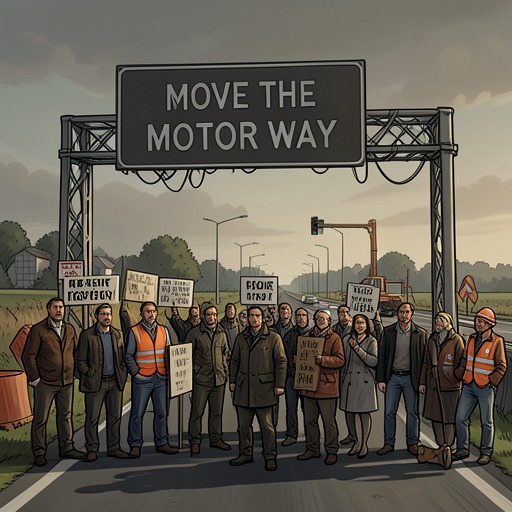
The motorway proceeded along its originally planned route. The Move the Motorway campaign delayed it for a considerable time through injunctions and constitutional challenges; Rob Ryan thinks the campaign may even have taken its case to the European High Court. A further delay came from protesters calling themselves Knocknafree, who camped at the site to prevent the bulldozers from passing. Rob suspects Mark Hanly may have been among them, though he presents this as a guess rather than a certainty.
The protesters’ presence bought only a few more weeks. The government obtained a court order against them, and Rob judges that they never had a realistic chance of stopping the project. He wonders whether Jonathan Devlin believed, despite the historical evidence, that public opinion might succeed this time, or whether he understood the odds and felt compelled to try anyway. Rob envies him either way. The thought gives the failed resistance a personal weight: trying to protect the site matters even when the eventual result appears settled.
Rob Ryan’s Return
Rob went to Knocknaree on the day he read in the newspaper that construction had begun. He was meant to be canvassing door to door in Terenure for witnesses to a stolen car used in a robbery, but he left that task for about an hour, confident that his absence would not be noticed. He cannot identify a clear reason for going. He does not describe the visit as a dramatic attempt to find closure; it is simply a belated impulse to see the place once more.
That modest explanation makes the visit a return without resolution. Rob arrives neither to intervene in the construction nor to pursue a new investigation. Instead, he stands before a changed landscape and discovers that his expectations had not prepared him for its scale. The site is already unrecognizable, and what he encounters exceeds the damage he had anticipated.
The Works and the Vanishing Wood
The machinery can be heard before Rob reaches the top of the hill. Workers in neon protective clothing move across the site, shouting commands that disappear beneath the noise. Large, grimy bulldozers toss aside clumps of earth and edge around the excavated remains of walls. The description places the archaeological remnants beside the machinery that is displacing them: the construction does not merely approach the old site but works directly through its exposed ground.
Rob parks at the roadside, where a small group of protesters has gathered on the still-untouched shoulder. They hold handmade signs calling to save the heritage and insisting that history is not for sale, apparently ready in case the media return. Chestnuts are beginning to fall again, a seasonal detail set against the earth being churned up for the road. The protesters’ signs preserve a public claim for the site, but they cannot halt the work already visible beyond them.
At first Rob reads the raw earth as larger than the archaeological dig had seemed. He then understands why: the last strip of wood is almost gone. Pale, splintered trunks stand with their roots exposed and thrusting toward the gray sky, while chainsaws cut at the few trees left. The destruction unfolds as an active process rather than a completed event. The motorway construction has begun, the excavated ground is being disturbed, and the remaining trees are still being felled.
A Recovered Childhood Landscape
The sight brings back a bodily memory of climbing the castle wall. Rob recalls crisp packets crackling in his T-shirt, the river far below, Peter Savage’s runner searching for a foothold above him, and Jamie Rowan’s blond hair raised among the swaying leaves. His recollection is physical as well as visual: he remembers the scrape of stone against his palm and the strain in his thigh as he pushed upward into the green and the light.
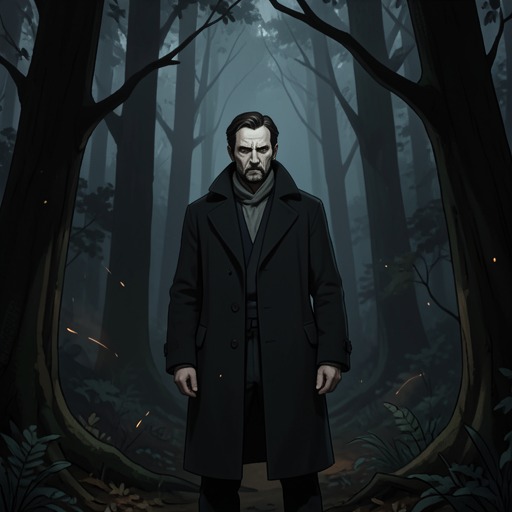
For much of his life, Rob had understood the wood as an enemy stalking the secret corners of his mind. Its destruction briefly unsettles that habitual image. He realizes that he had forgotten how much of his childhood it had also been an easy playground and a refuge he loved. Only when he sees the trees being cut down does he fully register that the wood had been beautiful. The returned memory does not erase the darkness associated with Knocknaree; instead, it restores a lost contrast between the place that held fear and the place that once offered freedom.
The scene therefore binds the road’s physical advance to a change in Rob’s perception. The site’s destruction is not presented as an abstract dispute over development: it is made visible in the exposed roots, broken ground, archaeological walls, and disappearing trees. For Rob, the loss also gives shape to something he had not previously recognized—that the landscape he remembered as threatening had contained a cherished childhood refuge. His return cannot stop the bulldozers, but it allows him, as the wood vanishes, to remember what it had been before its darker meanings took hold.